Case Study

Aera

Author:
David Frank
Published:
January 2026
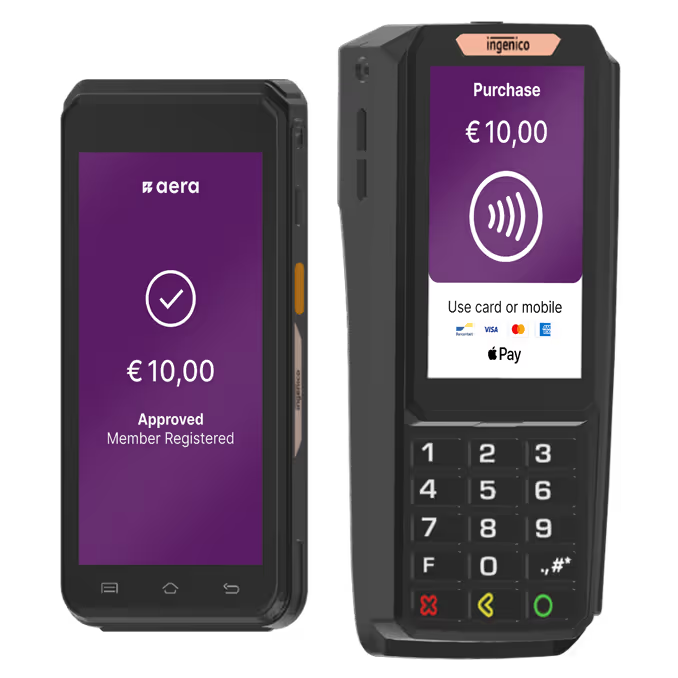
Aera is a payment terminal manufacturer operating in the fintech and digital payments sector, developing and maintaining its terminal software fully in house.

About Aera

Aera is a technology company specializing in secure digital identity, biometric authentication, and payment terminal solutions. Operating at the intersection of hardware, software, payments, and identity infrastructure, Aera develops advanced terminal and authentication systems designed to enable fast, reliable, and secure user verification and transaction processing in real world payment environments. 

Aera is actively developing its own payment terminal software in-house, maintaining full control over the quality, security, and evolution of its platform. This approach allows the team to iterate rapidly, introduce frequent updates, and respond quickly to newly discovered issues, with development cycles reaching up to two to three software versions per week. As a result, testing and validation play a critical role in ensuring stability, accuracy, and consistency across every release. 

The company places strong emphasis on precision, repeatability, and real-world reliability, particularly when validating payment transaction flows, terminal behaviour, and user-facing display messages. With a focus on building robust and future-proof identity solutions, Aera relies on thorough regression testing and continuous quality assurance to support its fast-paced development environment and high security standards. 

The Challenge

Before introducing test automation, Aera relied almost entirely on manual regression testing to validate its payment terminal software. Each test cycle required testers to physically execute close to 200 test cases by hand, covering transaction flows, card interactions, and verification of terminal display messages. While this approach was manageable in the early stages, it quickly became unsustainable as development accelerated. 

Aera develops its payment terminal software fully in house and releases new versions frequently, with multiple updates sometimes delivered within a single week. This high release frequency placed increasing pressure on the QA process, making manual regression testing difficult to scale and inconsistent across the team. 

“We had basically almost 200 test cases that we just did by hand. For me it took around two hours, but for others it could take the whole day,” comments Kristoffer Skjønhaug, Tester at Aera. 

Beyond time constraints, manual testing introduced additional challenges related to consistency and reliability. Repetitive execution made it difficult to guarantee identical test conditions across runs, increasing the risk of human error and missed defects. Validating visual elements such as terminal screens, approval or cancellation messages, and end of transaction displays required constant manual comparison, making subtle regressions easy to overlook. 

Reproducing bugs was also time consuming. When an issue appeared, testers had to manually repeat complex interaction sequences to trigger the same behavior again, slowing down investigation and resolution. As regression cycles increased, this manual approach consumed valuable engineering time that could otherwise be spent on improving test coverage or advancing product development. 

As Aera’s software matured and release frequency increased, the team recognized that their existing testing process no longer aligned with their speed or quality expectations. They needed a way to run regression tests more frequently, more consistently, and with less manual effort, while still testing real payment terminals under real world conditions. When Aera learned about PaytestLab, they realized there were test automation solutions capable of meeting these needs far more effectively than their existing approach. 


The Solution

To address the growing demands of its fast-paced development cycle, Aera turned to PaytestLab to introduce test automation into its payment terminal testing process. The goal was not only to reduce execution time, but to achieve repeatable, real-world testing that could keep up with frequent software releases while maintaining high quality standards. 

PaytestLab provided a solution that directly replaced Aera’s most time-consuming manual tasks with reliable automation. By deploying PaytestRobot, Aera was able to automate physical card interactions and payment terminal workflows that previously required constant human involvement. This allowed regression tests to be executed in a consistent and controlled manner, ensuring identical test conditions across every run. 

The implementation focused on automating regression testing for payment terminal software by connecting PaytestRobot, PaytestHub and the EMV L3 Player for the Fime BTT. Once configured, PaytestRobot was able to execute complete test runs unattended, including transaction flows and validation of terminal display messages. This eliminated the need for testers to manually monitor each step of the process and significantly reduced the risk of human error. 

In addition, PaytestLab enabled Aera to introduce visual validation into its testing strategy. By capturing and verifying terminal screens during execution, the team could automatically detect inconsistencies in user facing messages that would have been difficult to identify through manual testing. This capability improved defect detection while making bug reproduction faster and more reliable. 

Although the initial setup required onboarding and stabilization, the solution was fully integrated into Aera’s daily testing workflow. Once operational, PaytestHub in combination with the PaytestRobot allowed the team to run regression tests multiple times per day without additional effort, aligning the QA process with Aera’s rapid release cadence. The result was a scalable and future proof testing setup that replaced manual bottlenecks with automated, repeatable, and efficient execution. 

The Result

The introduction of automated testing delivered immediate and measurable improvements for Aera. Regression testing that previously required several hours of manual effort was reduced to a fully automated process completed in as little as 15 to 17 minutes per run. This dramatic reduction allowed the team to execute regression tests multiple times per day instead of limiting validation to a single daily run. 

With automation in place, Aera is now able to perform three to four full regression test cycles per day without additional manual effort. This shift significantly increased test coverage and confidence in every software release, while aligning quality assurance with the company’s rapid development cadence. What once consumed large portions of the workday is now executed unattended, freeing up valuable engineering time. 

Beyond speed, consistency and defect detection improved substantially. Automated execution ensured identical test conditions across every run, eliminating variability caused by manual input. Visual validation enabled the team to detect subtle issues in terminal display messages and user facing screens, including inconsistencies that would have been easy to miss during manual testing. Bugs could be reproduced instantly by rerunning the same automated test sequence, accelerating investigation and resolution. 

From a workload perspective, the impact was equally significant. By shortening regression execution from hours to minutes, Aera significantly reduced the manual effort required for each test cycle. Automation enabled the team to spend less time executing tests and more time validating results and improving overall test coverage. 

“This actually gives me time to focus on other stuff than just regression testing. Once it’s up and running, it’s really fast,” states Kristoffer Skjønhaug, Tester at Aera. 

Overall, PaytestLab’s test automation transformed Aera’s testing process from a manual bottleneck into a scalable and reliable quality assurance workflow. The ability to run frequent, consistent, and unattended regression tests strengthened software quality, improved developer confidence, and supported faster and more stable releases as the platform continues to evolve. 

Download Case Study PDF

Related Case Studies

KWI

Faced with increasing regression demands and the limitations of manual card testing, KWI turned to PaytestLab’s PaytestRobot to automate real-world payment transactions across

Read More »

Worldline Belgium

Worldline is a leading global provider of payment and transactional services, operating in the fintech and digital payments sector. Known for offering innovative
Read More »

Abrantix

Abrantix is a Swiss software innovator in payment solutions, delivering advanced EFTPOS terminal software for secure, efficient global transactions. Known for quality and

Read More »

Ingenico Switzerland

Ingenico Switzerland, a vital subsidiary of the global Ingenico Group, pioneers secure and innovative electronic payment solutions, offering tailored services and cutting-edge payment
Read More »

Nexi Switzerland

Nexi Switzerland, an integral part of the European PayTech Nexi Group, is composed of a team of approximately 100+ dedicated individuals committed to

Read More »

Revel Systems

Revel Systems, with nearly 600 employees in multiple locations, offers a leading cloud POS platform. Unlike competitors, they collaborate with various payment providers,

Read More »

Contact Us for more

Scroll to Top