
Modern software development is built around speed, iteration, and increasingly continuous delivery. Development teams are expected to release new functionality faster while maintaining the reliability that users and businesses depend on. Practices such as continuous integration and continuous deployment (CI/CD) have helped make this possible by bringing development and testing closer together, allowing software changes to be validated earlier and more frequently.
In payment software, however, achieving the same level of continuity is more complicated. Card-present payment environments combine software with physical terminals, payment cards, PIN entry, contactless interactions, electronic cash registers, security requirements, and certification processes. While many software components can be incorporated into automated development pipelines, testing the physical payment experience introduces challenges that software automation alone cannot always solve.
The next stage of payment test automation therefore requires a broader approach. The objective is not simply to automate individual test cases, but to connect development, QA, physical payment testing, and payment QA test orchestration into a continuous process. This means considering how real payment hardware can become part of modern development workflows, how QA teams can move away from repetitive execution toward higher-value quality work, and how emerging technologies such as AI could make automated testing increasingly adaptive and intelligent.
Why Payment Testing Remains Different
The complexity of payment testing is not new. The introduction of EMV significantly increased the testing and certification requirements associated with payment software changes, and the payment environment has continued to evolve through contactless payments, mobile transactions, tokenization, additional security requirements, and increasingly complex checkout architectures.
As a result, even a relatively contained software change can require substantial validation. Regression testing confirms that core functionality remains intact, while the nature of a change can also determine whether additional EMV certification or payment brand certification or re-certification is required prior to deployment. Certification therefore becomes part of the release timeline alongside development and QA, creating another consideration for companies providing or using card-present payment solutions that are trying to introduce software changes quickly.
This creates a difficult balance between speed and assurance. Product and development teams want to bring improvements to market quickly, while QA teams need sufficient coverage and time to establish that those changes have not introduced problems elsewhere in the payment flow. The stakes are also particularly high in payments: when payment software does not perform as expected, the impact can extend beyond the user experience to a merchant’s ability to accept transactions. Faster time to market is important, but it cannot come at the expense of payment reliability.
The physical nature of card-present payments makes this particularly difficult to address through conventional software automation alone. A realistic payment test may require a card to be inserted, tapped, or swiped, a PIN to be entered, a secure screen to be navigated, or multiple pieces of payment and checkout hardware to interact correctly. True automated payment testing therefore needs to validate the actual combination of software and hardware intended for deployment while preserving the physical interactions and security conditions of the real payment environment, rather than relying entirely on simulations or bypassing parts of that environment simply to make automated testing possible.
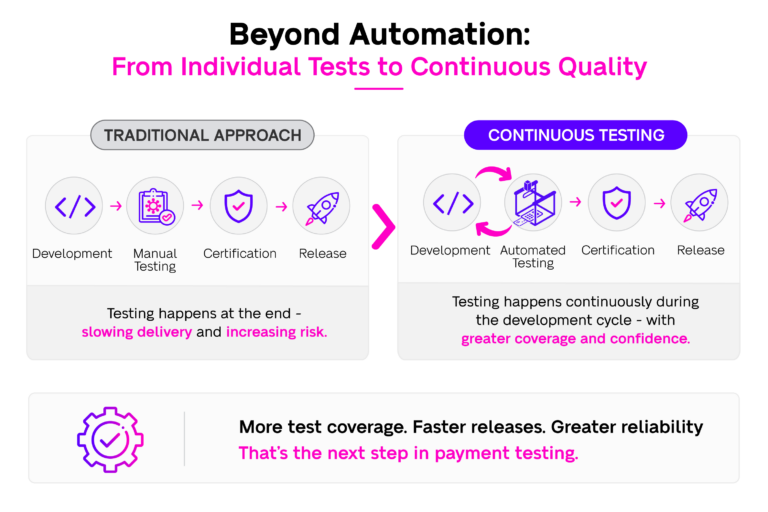
From Manual Testing to Automated and Continuous Testing
Speed is one of the most visible benefits of automation, but its value extends to greater test coverage, consistent and repeatable execution, scalability, and earlier defect detection. Together, these capabilities contribute to the two outcomes payment organizations ultimately need to balance: bringing software to market faster while maintaining confidence in its reliability.
In a predominantly manual environment, a QA team may focus its efforts on the functionality directly affected by a release because executing a complete regression suite would require too much time. The challenge is that even a seemingly minor change can unintentionally affect another part of the transaction flow. When regression tests can be executed automatically, there is less reason to restrict validation to the area that appears to have changed. A broader regression test for payments can become part of the normal development process rather than an activity reserved for major releases or final QA.
The value of automation is therefore not simply that the same test can be performed faster. It allows teams to test more frequently and comprehensively without creating a corresponding increase in repetitive manual work. That shift provides the foundation for bringing payment testing closer to CI/CD and making validation a more continuous part of software development.
Completing the CI/CD Pipeline
CI/CD is a fundamental part of modern software development and testing, allowing teams to make changes, validate them quickly, integrate them into the wider software environment, and move toward deployment more efficiently. In software-only environments, automated frameworks can perform much of this validation directly, with changes triggering tests and results returning to development teams without requiring someone to reproduce each scenario manually.
Card-present payments introduce a physical boundary, that bringing payment hardware directly into that process. An organization may have mature CI/CD practices across its software components but still reach a point where a physical terminal, payment card, PIN entry, contactless transaction, or another hardware interaction requires manual testing. At that point, the automated pipeline becomes disconnected from the real environment in which the payment software ultimately needs to perform.
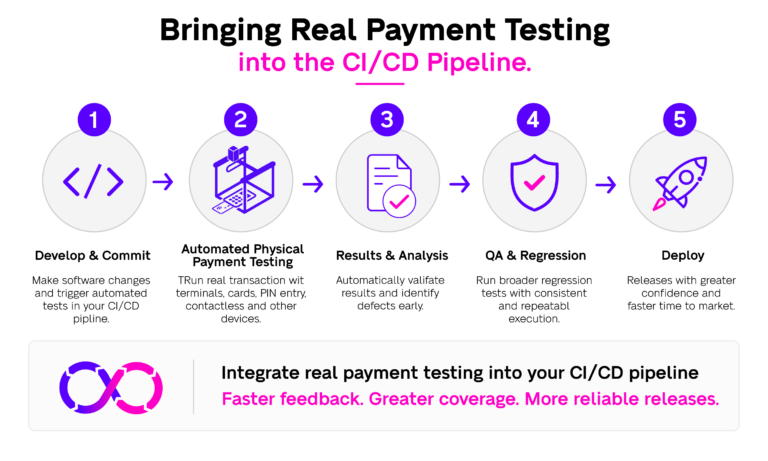
Terminal test automation and robotic payment testing bridge this gap by introducing physical, real-device interactions directly into the CI/CD payment pipeline. When terminal interactions, card selection, PIN entry, contactless testing, and other required actions can be orchestrated alongside software validation, real-device testing can move closer to the development cycle instead of waiting until development is considered complete.
This creates a much shorter feedback loop between development and QA. If comprehensive testing happens only after weeks of development, a defect may need to be traced through a long history of changes. When testing happens continuously or at shorter intervals, problems can be connected to a smaller set of recent changes, making them easier to identify, reproduce, and correct. Continuous testing therefore supports more than faster execution; it brings QA into the development cycle and helps software move toward deployment with greater confidence.
How Payment Test Automation Elevates the Role of QA
As repetitive testing becomes automated, the role of QA does not disappear but becomes more focused on the areas where human expertise provides the greatest value. Certain edge cases will still require manual validation when they are too complex or infrequent to justify automation overhead. The objective is not necessarily to eliminate every manual test, but to reduce the repetitive execution that consumes QA resources.
In a manual environment, QA engineers are responsible for both developing and maintaining test cases and repeatedly executing them. As test libraries expand, execution can take time away from analyzing coverage, refining scenarios, investigating results, and adapting the testing strategy as the software evolves. Automated test case execution changes this balance by allowing software and physical automation to handle more repetitive transactions while QA teams focus on improving the quality and relevance of the testing itself.
This can include identifying gaps in coverage, designing stronger edge cases, removing outdated or duplicated tests, investigating failures, and continuously refining the scenarios used to validate the product. Automation also reduces the practical limit on how much can be tested within a release window, allowing QA teams to expand meaningful coverage without creating an equivalent increase in manual workload.
Connecting the Entire Payment Testing Environment
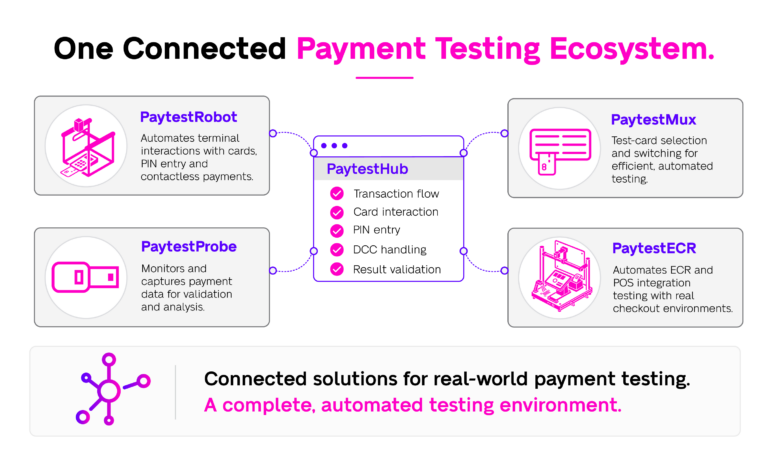
Automating the physical terminal is only one part of the challenge. A complete payment or checkout experience links terminals, cards, ECR or POS systems, external peripherals, backend components, and multiple software layers. Testing these elements independently does not necessarily validate how they work together, which is why payment automation needs to be approached as an interconnected ecosystem rather than a collection of isolated testing tasks.
The PaytestLab ecosystem is built for this interconnected reality. PaytestHub provides cloud-based payment test management and centralized execution, while products like PaytestRobot, PaytestProbe, PaytestMux, and PaytestECR orchestrate hardware interactions and testing requirements across the payment environment. Together, they allow every component involved in a checkout experience to be tested as part of a single, coordinated infrastructure.
The cloud-based model also separates where testing is controlled from to where the hardware physically resides. Terminals and automation infrastructure can remain in a laboratory or another location while development and QA teams access and manage testing remotely. This is particularly valuable for distributed teams and supports the broader goal of making physical payment testing part of a remotely managed, centrally orchestrated environment that can fit more naturally into modern development workflows.
Where AI Could Take Payment Testing Next
While automation addresses the execution challenge, AI creates opportunities to make payment testing more adaptive. It could help analyze requirements and specifications, support test case creation, identify which tests are most relevant following a software change, interpret what appears on a terminal screen, and assist in evaluating whether the expected behavior occurred during a test.
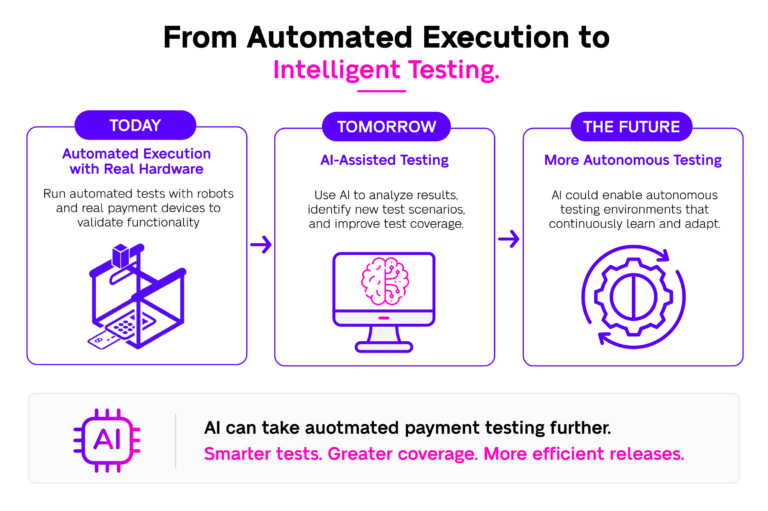
The longer-term opportunity is to combine that intelligence with physical automation. Instead of beginning only with predefined knowledge of what a terminal is expected to support, an AI-enabled testing environment could use robotics to explore transaction flows and identify available functionality. It could then compare what it discovers with specifications and deployment requirements to determine what should be present, what should not be present, and which tests are required. This could provide another layer of validation by identifying functionality or transaction paths that exist in the software but were not intended to be part of the release.
AI does not remove the need for physical automation in this model. It can help determine what should be tested, interpret information, adapt test logic, and evaluate results, but physical interactions still require a mechanism capable of performing them. The opportunity lies in bringing AI, robotics, and payment QA orchestration together so that automated testing becomes increasingly capable of understanding both what needs to be validated and how to validate it.
Beyond Automation
The longer-term evolution of payment testing is not simply about increasing the number of automated test cases. It is also about reducing the effort required to create, configure, and maintain automation. A future testing environment could increasingly recognize a terminal and its functionality, understand the requirements relevant to a deployment, determine appropriate test coverage, and coordinate the hardware and software required to execute those tests. This would represent a shift from automated test execution toward increasingly autonomous payment testing.
Automation provides the foundation for that evolution, robotics extends it into the physical payment environment, cloud-based test orchestration connects teams and infrastructure, and CI/CD brings validation closer to development. AI has the potential to make the process increasingly adaptive.
Together, these capabilities point toward a payment QA model in which testing becomes an ongoing part of how payment software is built, changed, validated, and released rather than a lengthy phase that begins only after development is complete.
For companies providing or using card-present payment solutions, the objective remains practical: test more of the real solution, identify problems earlier, improve meaningful test coverage, make better use of QA expertise, reduce unnecessary delays, and release payment software with greater confidence. Moving beyond automation does not mean leaving automation behind; it means expanding what automation can achieve until continuous, real-world payment testing becomes an integral part of the software development lifecycle.